



Werkzeuge
Globale Variablen verwalten
Über das Icon Globale Variablen verwalten öffnet sich ein Fenster, über welches Sie die globalen Variablen verwalten können. Dazu gehört das Löschen, Hinzufügen und Ändern von Standardwerten.
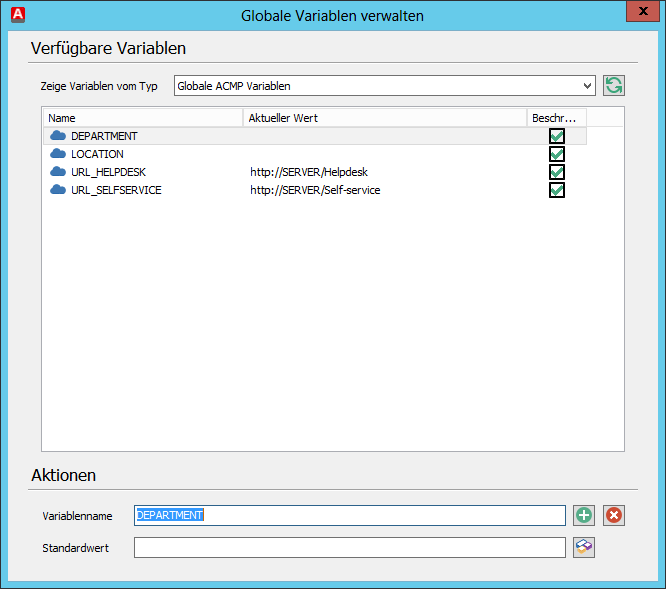
Globale Variablen verwalten
Der Umgang mit globalen Variablen entspricht dem mit einfachen Variablen. Weitere Informationen zu den einfachen Variablen finden Sie im Kapitel Variablen.
Funktionen
Funktionen sind global wiederverwendbare Client Commands, die über Eingabeparameter gesteuert werden können. Sie ermöglichen es, häufig benötigte Abläufe zentral zu definieren und in mehreren Client Commands zu verwenden. Dadurch werden Client Commands übersichtlicher und der Wartungsaufwand reduziert. Änderungen an einer Funktion müssen nur an einer zentralen Stelle vorgenommen werden.
Um eine Funktion anzulegen, wählen Sie in der Ribbonbar Client Commands > Erstellen > Werkzeuge > Funktionen.
Im geöffneten Fenster werden alle bereits angelegten Funktionen angezeigt. Hier können Sie allgemein Ihre Funktionen hinzufügen, löschen oder exportieren.
| Aktualisiert die Ansicht. |
| Löscht die markierten Funktionen. |
| Erstellt eine neue Funktion. |
| Erstellt einen neuen Ordner. |
| Zeigt die Funktionen als Liste oder der üblichen Baumansicht an. |
| Importiert eine Funktion. |
| Importiert alle Funktionen unterhalb einer bestimmten Pfadangabe. |
| Exportiert alle Funktionen innerhalb eines gewählten Ordners. |
| Zeigt die ausgewählte Funktion im Schreibgeschützen Modus an. |


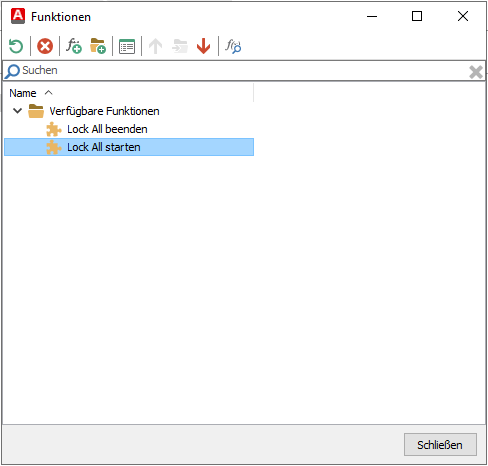
Verwalten der Funktionen
Klicken Sie auf  , um eine neue Funktion anzulegen. Es öffnet sich ein Editor, der dem Client Command Editor ähnlich ist.
 Hinweis:
 Stellen Sie dort die für die Funktion benötigten Befehle und Logiken zusammen und speichern Sie das Command über . Die Funktion wird anschließend in der Liste der vorhandenen Funktionen angezeigt.
Um eine Funktion in einem Client Command aufzurufen, verwenden Sie im Client Command Editor den Baustein „Execute function“. Wählen Sie die gewünschte Funktion aus und übergeben Sie die erforderlichen Eingabeparameter. Sofern ein Rückgabewert definiert wurde, steht dieser anschließend im aufrufenden Client Command zur weiteren Verarbeitung zur Verfügung.
AutoMATE kopieren
acmp AutoMATE ermöglich die Aufzeichnung von Aktion auf einem Windows-Client. Die Aufzeichnung kann später über acmp auf verwalteten Netzwerkclients ausgeführt werden, sodass z. B. Softwareinstallationen automatisiert und unbeaufsichtigt durchgeführt werden können.
Wie genau Sie AutoMATE Skripte erstellen und benutzen, erfahren Sie im Kapitel AutoMATE anwenden.