



The Log
In the log section of the Client Command Editor, you can track and monitor the execution history of client commands. This monitoring is particularly useful when testing the flow of a newly created client command or when investigating the cause of an error in a client command that did not execute successfully.
The log is divided into the Run Log and variable monitoring.
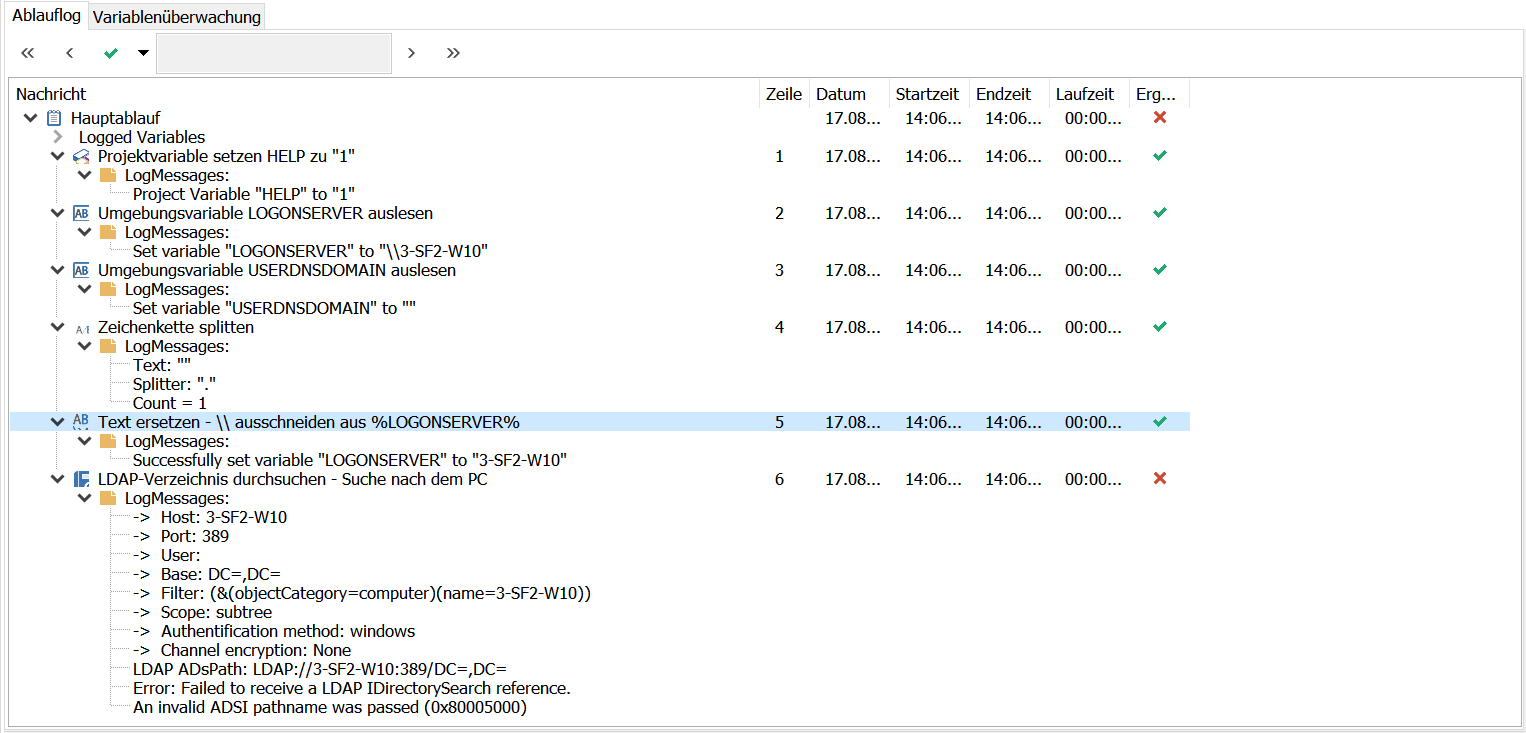
Log Area
Run Log
In the first part of the log - the Run Log - every Client Command executed by the loaded Client Command is listed in the order in which it was executed. The log structure thus resembles the script in the Script Area.
The Run Log appears in this section when you click  (Play) in the toolbar of the script area.
 Note:
Note: Each command executed within the Client Commands section contains additional, nested commands. These include detailed information about the execution, such as the variables and values used, or precise error descriptions if the command could not be executed successfully.

Executed command with nested commands
Furthermore, you can track the rows of the executed command in the actual script, the date, start and end times, the runtime, and the result (successfully or unsuccessfully executed) of the respective command.
Variable Monitoring
Within variable monitoring, you can monitor the values of the variables used during execution, for example, to identify errors.
It is not possible to view the execution log from a client there. Consequently, some commands may behave differently because, for example, elevated privileges are not available.
To add a variable for monitoring, right-click in the variable monitoring area and select the Add Variable option. A pop-up window containing all variables will open.
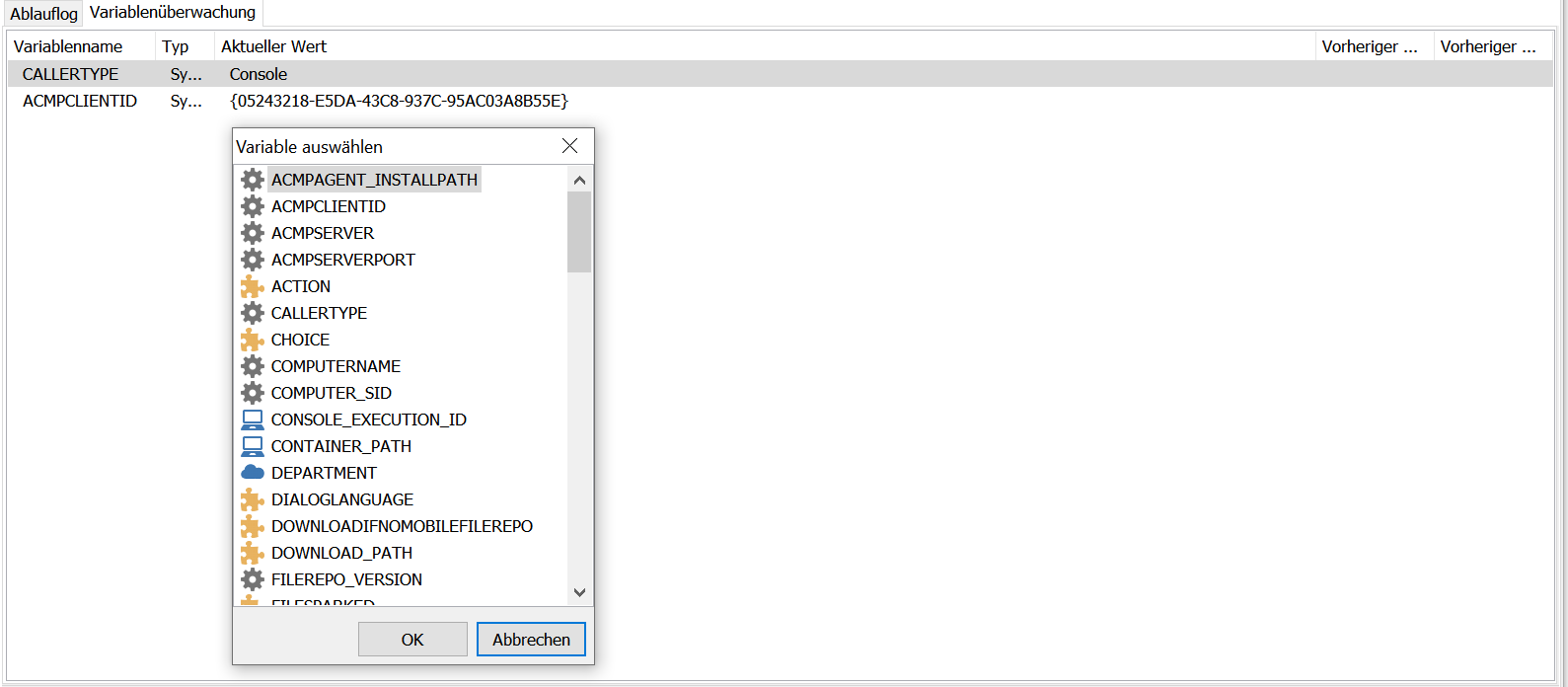
Variable Monitoring
Select the variable you want to monitor and click OK.
While the script is running, the current value as well as the two prior values are displayed here alongside the variable name and type. This allows you to track a variable precisely and identify errors.
To exclude a variable from monitoring, right-click the variable you want to exclude and select the Remove Variable option.
Managing Log Files
To ensure that log files are saved at all, you can configure each Client Command individually to specify whether a log file should be created for that command.
This setting can be configured in the Client Command Log Options via Project > Properties > Client Command Specific > Options > Client Command Log Options.
Viewing Log Files
To view the saved log files, you have two different options within the acmp Console.
Option 1:
In the Execution phase, click the desired Client Command and then click Show Details in the lower section.
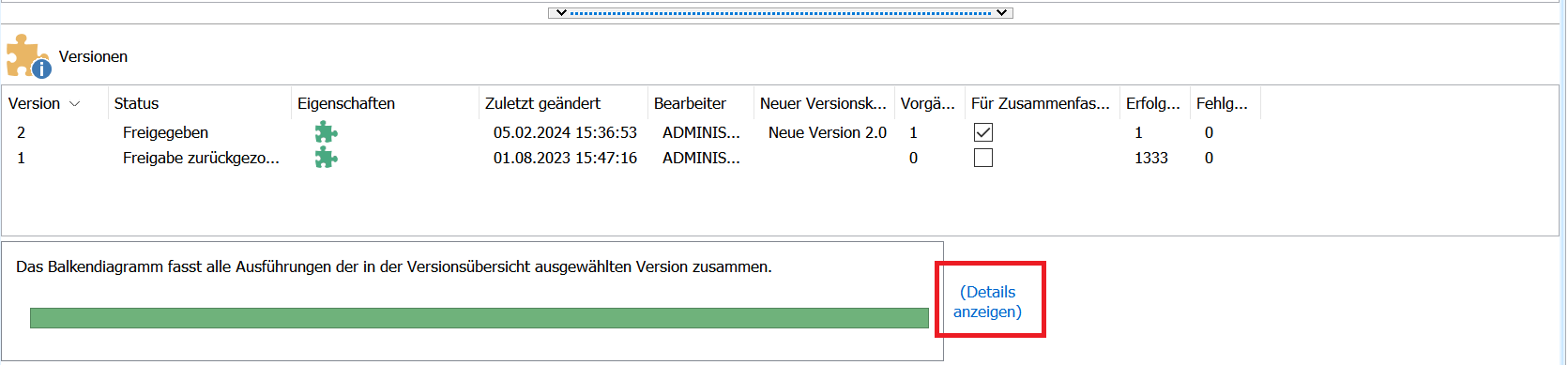
Option 1 for viewing log details
The following summary for the Client Command opens:
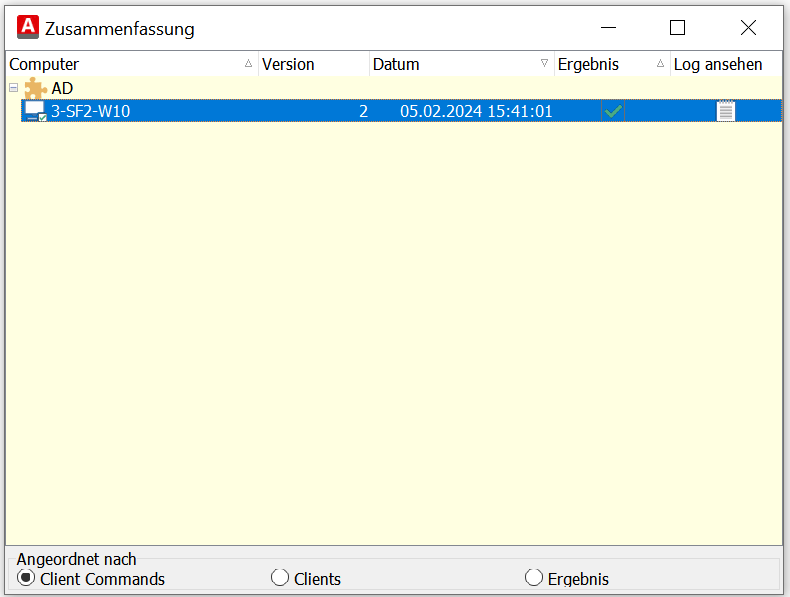
Log summary
Then click the View Log icon to open the Client Command Log Viewer.
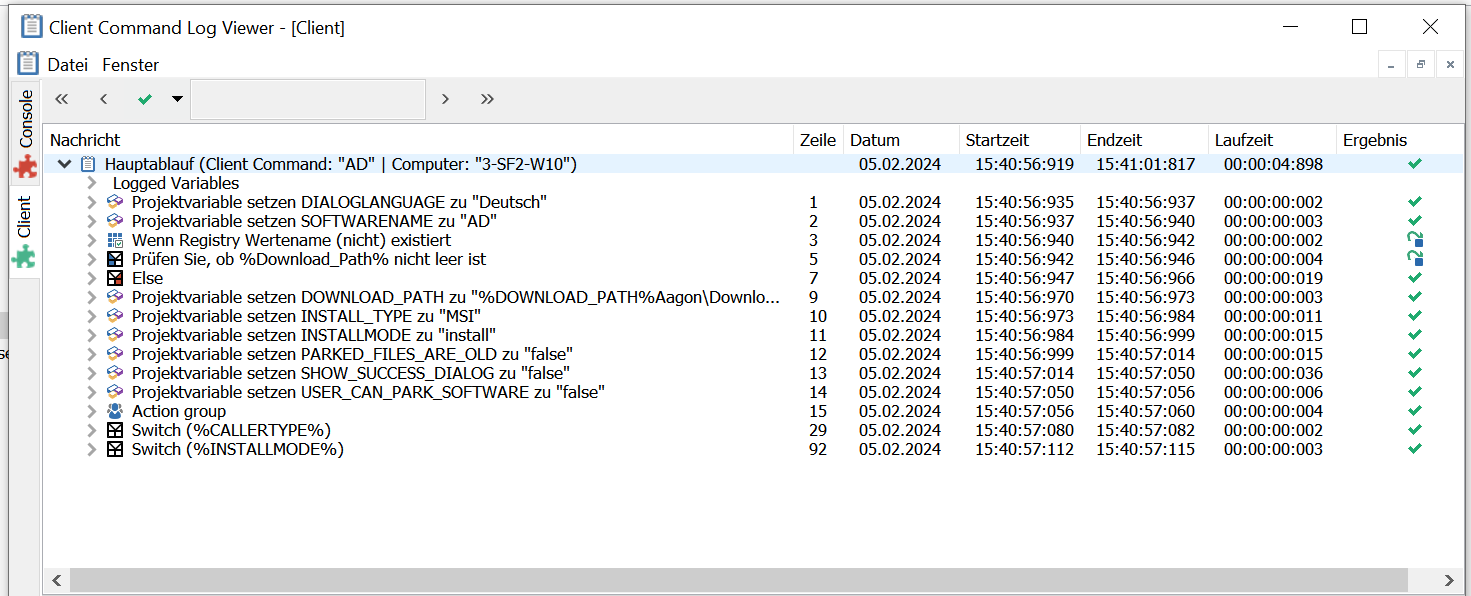
Client Command Log Viewer
Option 2:
Open a client’s Client Details and select logs under Client Commands.
Now click the View Log icon to open the Client Command Log Viewer.
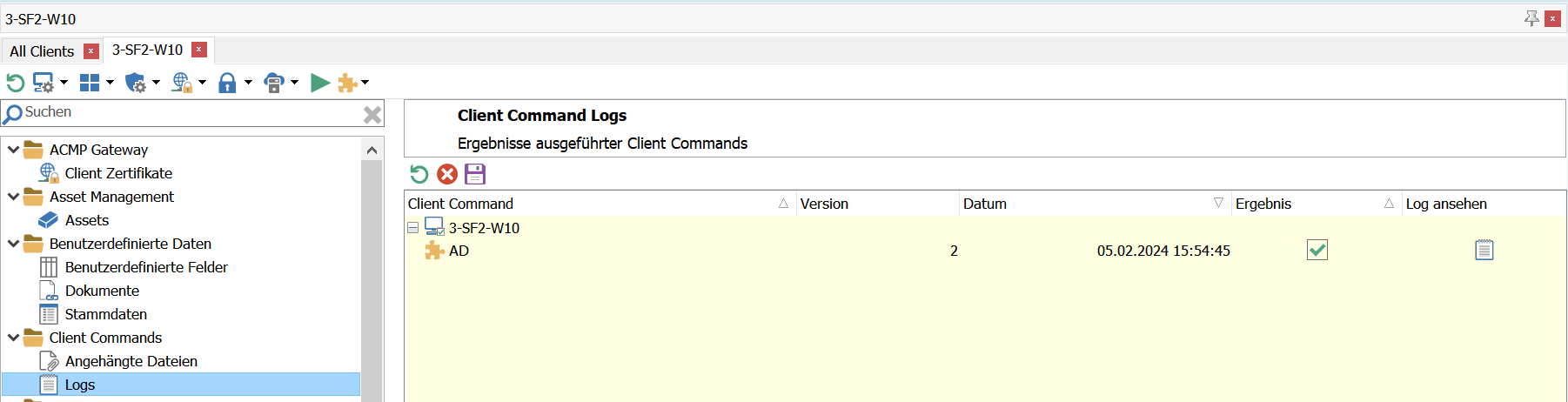
Option 2 for Viewing Logs
Exporting Log Files
You also have the option to export log files. There are two options for exporting:
Option 1:
Open a Client’s Client Details, select the log you want to export, and click Save  Log as File.
Then select the storage location and enter a name.
You will receive an .alf file that you can view with the Client Command Log Viewer. This tool is installed along with the acmp Console and is located in the Bin directory (e.g., C:\Program Files (x86)\Aagon\ACMP Console\Bin\ClientCommandLogViewer.exe).
Open the Client Command Log Viewer and add the .alf file via File > Open Logfile, or drag and drop the file into the Client Command Log Viewer.
Option 2:
Right-click to open the context menu of the Client Command Log Viewer. Select the storage location and enter a name.
You will receive an .alf file that you can view with the Client Command Log Viewer. This tool is installed along with the acmp Console and is located in the Bin directory (e.g., C:\Program Files (x86)\Aagon\ACMP Console\Bin\ClientCommandLogViewer.exe).
Open the Client Command Log Viewer and add the .alf file via File > Open Logfile, or drag and drop the file into the Client Command Log Viewer.